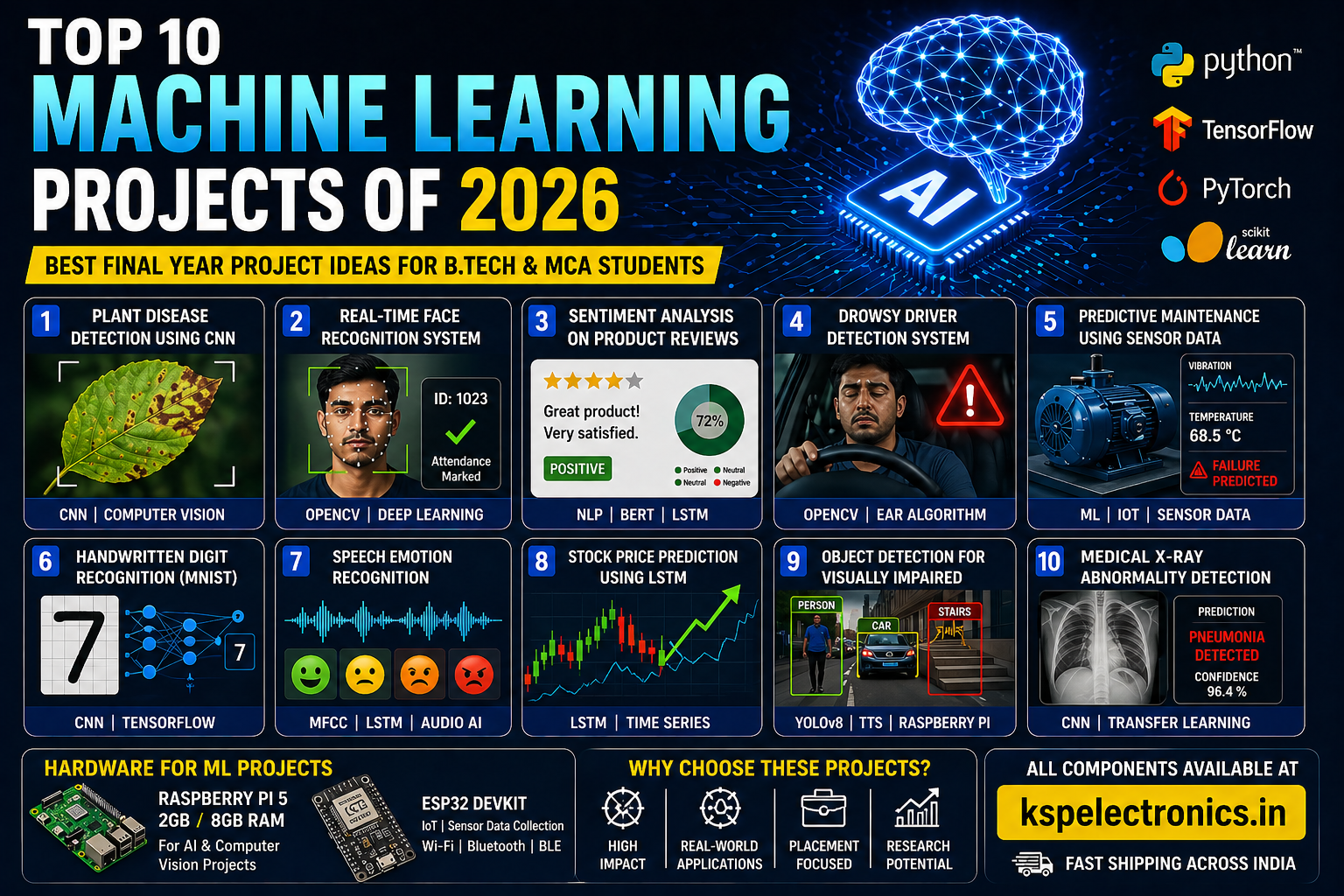
The top machine learning projects 2026 list has expanded significantly with accessible AI hardware and free cloud training tools. Here are the top machine learning projects 2026 for students and researchers. Machine learning is no longer a research-only field — it is now a core part of B.Tech, M.Tech, and MCA final year curricula across India. The availability of free frameworks like TensorFlow, PyTorch, and scikit-learn, combined with the Raspberry Pi 5’s edge AI capabilities, means students can build genuinely impressive ML projects with limited budgets. Here are the top 10 machine learning project ideas for final year students in 2026.
Top Machine Learning Projects 2026 for Final Year Students
1. Plant Disease Detection using CNN
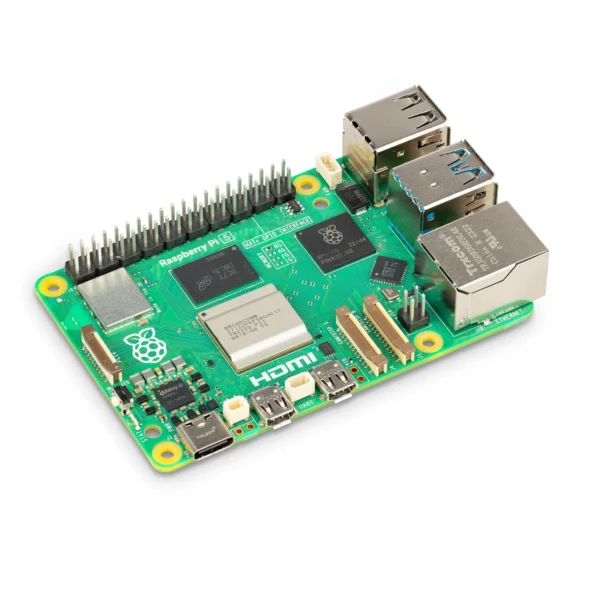
Train a Convolutional Neural Network (CNN) on the PlantVillage dataset to classify crop leaf diseases from images. Deploy on a Raspberry Pi 5 with a camera module for a real-time portable diagnostic tool. Accuracy of 90%+ is achievable with transfer learning from MobileNet or ResNet50.
2. Real-Time Face Recognition Attendance System
Use OpenCV and the face_recognition library on a Raspberry Pi 5 to build an automated attendance system that recognises students from a live camera feed and logs entries to a Google Sheet. This is one of the most commonly approved final year project topics in CS and IT departments across India.
3. Sentiment Analysis on Product Reviews
Build an NLP model using BERT or LSTM that classifies Amazon/Flipkart product reviews as positive, negative, or neutral. Deploy as a Flask web API. This project demonstrates NLP, model deployment, and REST API design — skills directly valued in industry.
4. Drowsy Driver Detection System
Use OpenCV’s Eye Aspect Ratio (EAR) algorithm with a dlib facial landmark detector to detect eye closure patterns indicating driver drowsiness. Trigger an alert buzzer connected to a Raspberry Pi GPIO pin when drowsiness is detected. Real-world road safety application.
5. Predictive Maintenance using Sensor Data
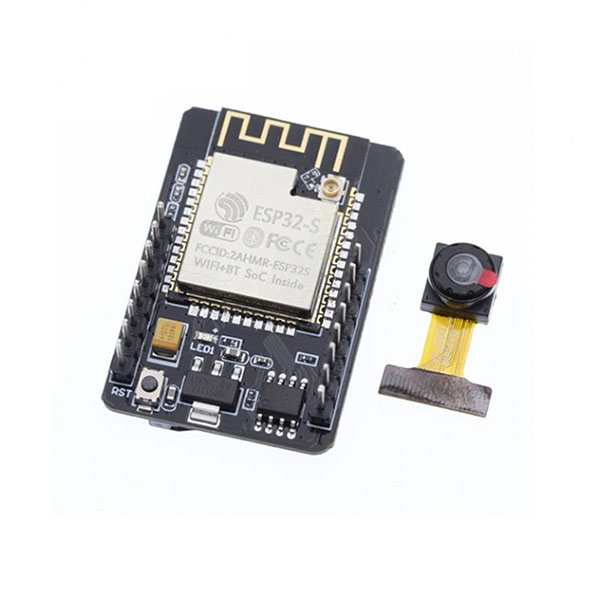
Collect vibration and temperature data from a motor using an MPU6050 and DHT11 sensor on an ESP32. Stream data to a Raspberry Pi running a scikit-learn Random Forest classifier trained to detect early signs of mechanical failure. Highly relevant for manufacturing and industry 4.0 topics.
6. Handwritten Digit Recognition (MNIST CNN)
A classic entry-level ML project that teaches the full pipeline: dataset loading, CNN architecture design, training, evaluation, and deployment as a web app using Flask or Streamlit. Achieves 99%+ accuracy on the MNIST dataset with a basic CNN in TensorFlow/Keras.
7. Speech Emotion Recognition
Extract MFCC (Mel-frequency cepstral coefficients) features from audio recordings and train an LSTM or CNN model to classify emotions (happy, sad, angry, neutral) from speech. Useful for call centre analytics, mental health monitoring, and voice assistant improvement.
8. Stock Price Prediction using LSTM
Use LSTM (Long Short-Term Memory) networks on historical NSE/BSE stock price data to predict next-day closing prices. While stock markets cannot be predicted reliably, this project teaches time-series analysis, LSTM architecture, and financial data preprocessing — all highly marketable skills.
9. Object Detection for Visually Impaired Navigation
Deploy YOLOv8 on a Raspberry Pi 5 (8GB) with a camera to detect and announce objects (person, door, vehicle, steps) via a text-to-speech engine. Combine with an ESP32 ultrasonic sensor for close-range obstacle alerts.
10. Medical X-Ray Abnormality Detection
Use transfer learning on the NIH Chest X-Ray dataset or COVID-19 CT scan dataset to build a classifier that detects pneumonia, COVID-19, or other abnormalities from X-ray images. This is a high-impact research project that often leads to paper publications and strong placement interview talking points.
Hardware for ML Projects: Raspberry Pi 5 at KSP Electronics
Common Mistakes to Avoid When Choosing a Microcontroller
Using a charge-only USB cable: This is the most common cause of “board not detected” errors. Always use a data-capable USB cable. See our driver troubleshooting guide if your board is not being recognised.
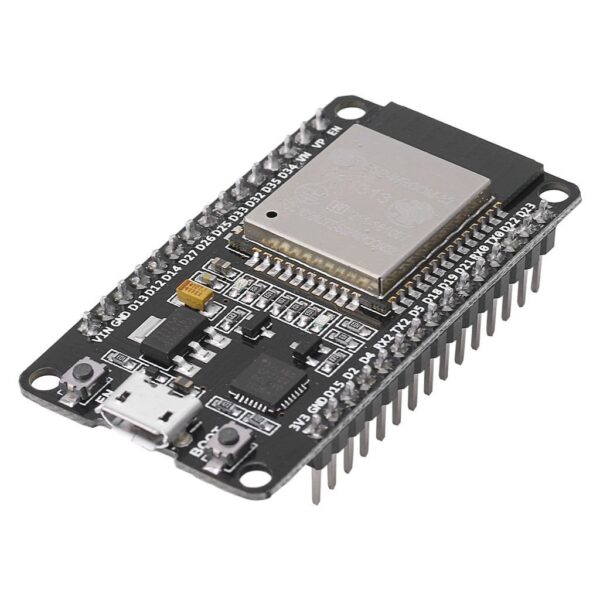
Connecting 5V sensors to ESP32 GPIO: ESP32 GPIO pins are 3.3V tolerant only. Use a voltage divider (10k + 20k resistor) to step 5V signals down to 3.3V.
Forgetting to install the board in Arduino IDE: ESP32 requires installing the Espressif board package separately. Arduino Uno works out of the box.
Not holding the BOOT button during upload on ESP32: Many ESP32 DevKit boards require you to hold BOOT while initiating upload, especially on first use. See our ESP32 project guide for IDE setup steps.
Frequently Asked Questions
Can I use Arduino libraries on ESP32?
Yes. Most popular Arduino libraries (Adafruit sensor libraries, DHT, Wire, SPI, etc.) are compatible with the ESP32 since it uses the Arduino framework. Some libraries with hardware-specific code may need the ESP32 variant to be installed separately, but this is rare for commonly used libraries.
What is the best microcontroller for a B.Tech IoT project?
The ESP32 is the best choice for most B.Tech IoT final year projects in 2026. It has built-in Wi-Fi and Bluetooth, runs on the Arduino IDE, costs ₹496–520 at KSP Electronics, and is powerful enough for real-time sensor data collection, cloud uploads, local web servers, and BLE communication — all in one chip.


 IoT Projects
 ML Projects
 Training